I'm at Spannocchia (a 900-year-old farmhouse near Siena), sitting outside on a cool, sunny day at a rickety round table, about the size of a large pizza, on the lawn overlooking the hills of Tuscany.
They took the lemon trees inside yesterday. Winter is coming. The two cypress trees and bench that I woodblock printed with Sabra Field five years ago are to my left. I have such fondness for that time in my life. The last time I came to this magical place, I'd just finished STILL ALICE. And here I am again, this time in the middle of writing my third book.
I can smell lunch cooking. Onions and garlic. And fennel? Not sure. It smells delicious. People are chatting behind me on the terrace where we drank wine every evening five years ago. We don't drink there now because it's November and too cold (last time I was here, it was June).
A man is picking something from a tree and dropping it into a ceramic bowl. Something for dinner maybe. I love how connected Italians are to their land, the earth, their food. Back at home, my yard is a place where my kids play or ground that I walk over to get to the car. Here, it is tended to and touched daily. It is eaten. I like that. It's what we should be doing. Connection to the earth and what we eat, nourishing our environment and ourselves. At home, we go to the grocery store. We're disconnected from this process.
Connection and disconnection. LOVE ANTHONY is about this. Faith and loss of faith. Communication and silence. Connection and isolation. How do we love? What do we need in order to experience love?
I've written the novels Still Alice, Left Neglected, and Love Anthony. Here are some thoughts, observations, and lessons learned along the way...
Tuesday, December 13, 2011
Thursday, December 8, 2011
Notes from My LOVE ANTHONY Writing Journal, 11/30/11
Just realized I'm on chapter 20. Sounds substantial, doesn't it? I'm at about 46,000 words and 200 pages, so it's getting there, baby. I go back and forth lately between thinking it's brilliant to thinking it's an absolute mess. I'm worried that Beth's story doesn't tie in strongly enough to Olivia's, that it's like--SO WHAT? Why not just tell Olivia's and Anthony's story?
I think because their story is too internal. Beth's story provides the movement, the action and immediacy. But why not tell Olivia's story in that way--tell the story of this mother who has a son with autism, how she first suspects it, then the diagnosis, living with it, etc--and make it linear? Because that's too predictable. It's been done. Mother has a child, expects a "normal" life, then there is a diagnosis and a deviated development, a deviated life. This mother's point of view has been told.
I'm hoping that this story offers something new and unexpected, that readers will learn about the experience of autism from the more severely affected end of the spectrum without feeling like they're reading a clinical manual, without being hit directly over the head with it. I want to tell a great story and give a voice to this voiceless child. How does he experience the world, emotions, relationships? How does his life matter? I want readers to experience what it might feel like to have this kind of autism. I think a straightforward, linear story of only Olivia and Anthony without Beth doesn't hold as much power somehow.
So finish the first draft, Lisa, and if there are ways that you can tighten Beth's ties to autism in metaphor, do it then. You've planted the seeds. Make sure that elements from each Anthony and Olivia chapter tie in to elements of Beths' chapters--illustrate that the spectrum is long and wide, and we're all on it. And then it will be brilliant, my dear. And when the first draft is done, have Tracey read it, and listen with an open heart to her feedback.
For now though, you are writing chapter 20. So what happens next?
I think because their story is too internal. Beth's story provides the movement, the action and immediacy. But why not tell Olivia's story in that way--tell the story of this mother who has a son with autism, how she first suspects it, then the diagnosis, living with it, etc--and make it linear? Because that's too predictable. It's been done. Mother has a child, expects a "normal" life, then there is a diagnosis and a deviated development, a deviated life. This mother's point of view has been told.
I'm hoping that this story offers something new and unexpected, that readers will learn about the experience of autism from the more severely affected end of the spectrum without feeling like they're reading a clinical manual, without being hit directly over the head with it. I want to tell a great story and give a voice to this voiceless child. How does he experience the world, emotions, relationships? How does his life matter? I want readers to experience what it might feel like to have this kind of autism. I think a straightforward, linear story of only Olivia and Anthony without Beth doesn't hold as much power somehow.
So finish the first draft, Lisa, and if there are ways that you can tighten Beth's ties to autism in metaphor, do it then. You've planted the seeds. Make sure that elements from each Anthony and Olivia chapter tie in to elements of Beths' chapters--illustrate that the spectrum is long and wide, and we're all on it. And then it will be brilliant, my dear. And when the first draft is done, have Tracey read it, and listen with an open heart to her feedback.
For now though, you are writing chapter 20. So what happens next?
Monday, November 28, 2011
Still Alice--Deleted Scene
My husband and I love watching the Deleted Scenes from the movies we rent. I love these bonus scenes because they give us a private peek into the creative process of that film. Those scenes were written, the actors memorized their lines. Time and money were spent on costume, lighting, makeup, direction. But some honest and brave editing minds decided that these scenes didn't serve the film as a whole, and they were cut. Out they went!
Manuscripts go through a similar editing process. If there are words, sentences, or scenes in the draft of my novel (and there always are) that don't serve the story as a whole, it's my responsibility to take them out. William Faulkner called it "killing your darlings."
I wish books, like rented movies, included a Deleted Scenes section at the back. Here's a deleted scene from STILL ALICE for you. It includes a character you don't know, Alice's friend Susanna. You don't know her because I deleted her entire character from the story. It didn't need her.
Sorry, Susanna darling, nothing personal. Just doing my job. Editing isn't for soft-hearted sissies.
"John?"
Manuscripts go through a similar editing process. If there are words, sentences, or scenes in the draft of my novel (and there always are) that don't serve the story as a whole, it's my responsibility to take them out. William Faulkner called it "killing your darlings."
I wish books, like rented movies, included a Deleted Scenes section at the back. Here's a deleted scene from STILL ALICE for you. It includes a character you don't know, Alice's friend Susanna. You don't know her because I deleted her entire character from the story. It didn't need her.
Sorry, Susanna darling, nothing personal. Just doing my job. Editing isn't for soft-hearted sissies.
"John?"
“Yeah?”
“We’re going to go take a walk down to the beach.”
“Alright, call me when you want me to come pick you up. You have your cell?”
She smiled and patted her baby blue Anna Williams bag. Satisfied with that answer, he kissed her, squeezed her hand, got in their car and pulled away.
Susanna arrived in Chatham five hours ago, and Alice was running out of time. John insisted that Susanna know about her Alzheimer’s before he left for Philadelphia in the morning. He was anxious to detail for her the rules and regulations surrounding Alice’s medication, her running routine, her cell phone, the Safe Return program, and to give Susanna her neurologist’s and his phone numbers, just in case. When she played this instructional speech in her head, it sounded very much like the ones she and John had delivered to their teenaged babysitters before leaving their children for weekends away in Maine or Vermont. She remembered feeling so excited to get away on those weekends, but also nervous about leaving their children behind with someone else to watch them. Anxiously pulled in opposite directions. Now she needed to be watched. This is how I want you to look after Alice while I’m out. She imagined that he might’ve actually composed a list that he planned to magnetize to the refrigerator. He was nervous about leaving her behind. Was he also excited to get away? Anxiously pulled in opposite directions.
She asked him if he would let her tell Susanna herself, and she promised that she would, but they’d just finished eating dinner at the Squire, and she hadn’t yet mustered up the courage to reveal her sad secret to her dearest friend. She felt completely clear-headed today. She’d come to recognize the difference between days that would be fraught with difficulties finding memories and words and bathrooms and days that her Alzheimer’s would lay silent and not interfere. On those quiescent days, she was her normal self, the self she understood and had confidence in. On those days, she could almost convince herself that Dr. Davis and the genetic screening had been wrong, or that the last six months had been a horrible dream. Only a nightmare, the monster under her bed and clawing at her covers not real. She was having one of those days today, and she wanted to hold on to being normal with Susanna for as long as possible.
They walked down Main Street without talking. The line of luxury cars and SUVs parked along the curb, outfitted with bike racks and kayaks bungeed on roofs, crammed with baby strollers, beach chairs and umbrellas, and sporting license plates from Connecticut, New York and New Jersey in addition to Massachusetts was an indisputable indication that the summer season was officially in full swing. Families walked along the sidewalk without regard for lanes of pedestrian traffic, unhurried and without specific destinations, strolling, stopping, backtracking and window-shopping. Like they had all the time in the world.
An easy, ten-minute stroll removed them completely from the bustling evening of downtown, early-July Chatham. As it always did, the spectacular view of Lighthouse Beach from the road filled her with awe and gratitude. They walked the thirty steps down to the sand. A modest row of sandals and flip-flops were waiting at the bottom where they’d been kicked off earlier in the day. It was nearing sunset, and there weren’t many people left on the beach. The sign in front of them read:
Warning: Strong Current. Surf subject to unexpected life-threatening waves and currents. No lifeguard. Hazardous area for: Swimming and wading, diving and water skiing, sailboards and small boats, rafts and canoes.
Aside from sand, water and sky, Lighthouse Beach shared little or nothing else in common with Hardings. At Hardings earlier that day, the water was pleasant and welcoming, and Nantucket Island could be seen in the distance. At Lighthouse Beach on the same day, the water was choppy and wild, and Alice knew from brief experience and reputation that is was always painfully cold. And, there was nothing to see in the distance but more ocean, nothing else between here and Europe. It was vast, impersonal, a little scary.
The breaking waves were relentless, powerful and loud, rumbling and churning, pounding at its shore. If it weren’t for the colossal seawall constructed at the edges of the properties of the million-dollar homes along Shore Drive, the ocean would’ve taken each house in, devouring them all without sympathy or apology. Alzheimer’s was like this ocean at Lighthouse Beach, unstoppable, ferocious, destructive. Only, there were no seawalls in her brain to protect her memories and thoughts from the onslaught.
Susanna hadn’t yet mentioned Greg. She probably wanted him to be here, but Alice requested in an email, without explanation or excuse, that she come to Chatham alone. Susanna replied with the word “fine”. It was equally vague without knowing the tone, but Alice guessed she was pissed. But, if she’d hinted that there was something important that she needed to tell her, Susanna would’ve dragged it out of her that day, over the phone, and Alice didn’t want to tell her like that. She wanted to tell her friend face-to-face, and she wanted to spend the week alone with her, without John and without Greg. It’s not that she didn’t want to meet Greg, but she didn’t want the week made superficial with good manners and appropriate guest considerations and entertaining. Even if they had another opportunity to spend a week together in the near future, this disease only got worse. She may not understand what her friend meant to her in the future. It was time to be a little selfish.
“I know you probably wanted to bring Greg.”
“I absolutely wanted to bring Greg.”
Well, now she knew. She was pissed.
“I know.”
“No, you don’t know. If he were my husband, you wouldn’t even think of not inviting him. I’d never tell you not to bring John or the kids. I accept your life and everything and everyone in it, but you don’t accept mine.”
“I do, Suz. This isn’t about him.”
“Then what, what is it about?”
“I have something to tell you, and it really can’t wait, and I couldn’t imagine combining what I have to tell you and the week I want to have with you with meeting Greg.”
“Well? What is it?”
Here it was, the moment she had to cross over. No more normal.
“I have Alzheimer’s Disease.”
She saw Susanna’s defensive anger leave her muscles and posture and drift away. She saw the fight in her pickle green eyes dissolve into fearful questioning. She waited a long time for Susanna to speak the questions her eyes asked. But they just stayed there.
“I was diagnosed in January, we told the kids over Easter. I couldn’t tell you over the phone, I have a really hard time on the phone now. And I couldn’t email this.”
The questions in Susanna’s eyes, now blurry with tears, begged for some other answer.
“I’m forgetting things, I’m getting confused and lost, I’m making all sorts of bizarre mistakes.”
It was news neither of them wanted to hold, but they’d been burdened with this kind of load before, and they were strong enough to carry it together. Susanna finally spoke.
“What’s going to happen to you?”
“It’s Alzheimer’s. You know what’s going to happen.”
“But there’s got to be something that can at least stop it from progressing?”
Alice watched the tide coming in, erasing footprints, demolishing an elaborate sandcastle decorated with shells, filling in a hole dug earlier that day with plastic shovels, ridding the shore of its daily history. She envied the beautiful homes behind the seawall.
“No, there’s nothing.”
“But we’re too young for you to have Alzheimer’s. It’s just wrong. It has to be something else.”
This was, predictably now, everyone’s rebuttal, including her own, what seemed like so very long ago. It just wasn’t valid. In fact, the first patient ever diagnosed with Alzheimer’s, a woman named Auguste D, was fifty-one when she was first admitted to a hospital in Frankfurt with symptoms of abrupt personality changes and profound memory loss. She died at the age of fifty-six.
“No, it’s definitely Alzheimer’s. You can be this young. I’m positive for a mutated gene that causes it.”
“How long before--?”
“I don’t know. They don’t know. Two years, twenty years. Hopefully, long enough for me to meet Greg.”
Susanna smiled, but her eyes didn’t agree.
“Do the people at Harvard know?”
“No, but I probably won’t be able to keep it hidden too much longer.”
“What are you going to do?”
“About Harvard?”
“About everything.”
“I don’t know. I thought about trying to write one last paper. But, it would really be so hard for me now. I could do it, but it wouldn’t be my best work, not even close. Not what I want to be remembered by.”
Alice Howland, is best remembered for ‘Molecules to Mind’, a ground-breaking text coauthored with her husband, John. It was her proudest written achievement, her words and ideas blended with John’s, creating something together that was unique in this universe, informing and influencing the words and ideas of others. She’d assumed they’d write another.
“Right now, I’m just living in my life, continuing the best I can at Harvard, trying to contribute for as long as I can and trying to really notice and enjoy all of the details in everything while I still can. I don’t know what else to do. What would you do?”
“I don’t know. If I could bring myself to leave my bed, probably the same thing. It’s what we should all be doing, actually. What are you going to do when you have to leave Harvard?”
“No idea. I’ve been terrified to think about it.”
“How long have you known about this?”
“For sure, since January.”
“I can’t believe you’ve been going through all this without me. I hate living so far away from you. How’s Johnny handling this?”
“Really well in some ways and not so well in others. I don’t think he’s entirely accepted that this is happening. I think he actually thinks he’s going to come home from this conference with a cure for me. And there just isn’t one. I’m worried about what it’ll do to him when he realizes that. And I’m worried about what this is going to do to him as I get worse.”
“Have you thought about taking some time off and traveling together?”
“We’ve both already traveled everywhere. There’s nowhere that I’m really dying to see.”
“Still, it might be nice to get away, go somewhere beautiful and relax without a conference or symposium lecture hanging over your heads.”
It wouldn’t matter where they went, her Alzheimer’s was coming with her. There was nowhere to run, no vacation from dementia.
“True, but that’s what this place is for us. I love it here. And being here on the Cape, the kids can come and visit.”
“How are the kids?”
“Anna—Anna…”
She was trying to say that Anna was positive for the same mutation, but her voice became unexpectedly flooded with emotion, and her breath was involuntarily redirected from the task of speaking to crying. She hadn’t spoken of Anna’s genetic testing results to anyone other than Anna since Easter. They were hugging each other now, both crying. It felt so good. Susanna’s arms had always been a safe place for her to cry. It was several minutes before Alice was able to finish her sentence.
“Anna and Tom underwent the same genetic testing I did. Anna has what I have.”
“Oh my God. What about Tom and Lydia?”
“Tom’s fine, and Lydia won’t get tested.”
“Of course.”
They both laughed a little.
“Anna’s okay though. She’s not looking at this like a death sentence. The best thing to come of this, I guess, is that she’d been trying to get pregnant and couldn’t. So now she’s doing in vitro, and because they know she has the mutation, they can actually test the embryos as well and only implant the ones that are mutation-free. So we’ve all been focusing on the fact that Anna is going to have a baby that won’t get Alzheimer’s. It’s truly amazing what they can do.”
“But what about something truly amazing for you? There’s got to be something. What about clinical trials?”
“I’m in one. But, I don’t even know if I’m getting the drug or a sugar pill. I’ve read everything about this disease and everything about this drug. They may be on the right track with this one, but I don’t think it’s the magic bullet.”
“So maybe your progression will be really slow. You caught this really early, and your progression will be slow, and they’ll discover the magic bullet in time for you.”
“Maybe.”
“Alice, you’re going to be okay. You can hold on for the magic bullet and get through this.”
Susanna had told her that she was going to be okay before. She’d said it with the same tenderness and conviction that was in her voice now. Alice believed her whole-heartedly thirty-two years ago, and that magical belief helped move her through the morning of her mother’s and sister’s funeral, their birthdays, holidays, her graduation, her wedding day. And Susanna had been right. Eventually, Alice was okay. But Alice didn’t believe her now. She wished that she did.
“And you’re too smart anyway. You can afford to lose a few brain cells. This is just God’s way of showing you what it’s like to be the rest of us.”
They both smiled. The sun, low and impossibly big in the pink and blue sky, was readying to plunge into the Altantic. This wild and dangerous ocean before her was as beautiful as anything she’d ever seen. She wondered if Auguste D had ever seen something this beautiful before being admitted to that asylum in Frankfurt.
“What should we do?” asked Susanna.
“About my Alzheimer’s?”
“No, together, tonight, right now.”
“Want me to call John to come get us?”
“No, not yet. Let’s go enjoy the view and a big fat glass of wine from the Chatham Bars Inn.”
“Perfect. Oh, you’ll love this. The antioxidants in red wine and dark chocolate are thought to be as effective at treating this as any drug.”
“Alright then, my love, let’s go get you some medicine.”
Tuesday, November 1, 2011
Oh Canada!
2011 will be remembered by me as the Year I Went to Canada. Before 2011, I'd never been. I wasn't allowed to go on my high school class trip to Montreal, and I believe my brother's hockey team traveled north at least once to play a Canadian team, but I stayed warm and snug at home.
And I originally met Mike, his wife Sue, and his sister Karyn online when doing research for LEFT NEGLECTED. Mike has Left Neglect. We've been in touch quite a bit since and have become good friends, and it was so much fun to spend a little time with them in Saint John.
That all changed this year. I went to Toronto twice in February, both times to promote LEFT NEGLECTED (note to Simon & Schuster--how about promoting my books in Hawaii in February? Just a thought). The second February trip was for an Indigo Book Event with Jeannette Walls (author of The Glass Castle and Half Broke Horses) and Elena Gorokova (author of Mountain of Crumbs) hosted by Heather Reisman. An amazing event!
The next time I traveled to Canada was in October, also known as The Month I Was in Canada. I went to Toronto, Vancouver, Saskatoon, Montreal (finally!), Ottawa, and Halifax on a speaking tour---the Coping with Care series sponsored by Dundeewealth. I spoke to audiences about the emotional effects of living with Alzheimer's and then tax expert, Evelyn Jacks, spoke about financial planning for aging and ailing parents. We fielded questions, and I signed books. And then we went to the next airport and hotel. We (along with the wonderful people from Dundeewealth) were a great team, and it actually feels strange now to travel anywhere without them.
To wrap up my tour of Canada, I then went to Saint John to give a similar talk about STILL ALICE and Alzheimer's for the St. Joseph's Hospital Foundation.
Although I was in Canada for much of October, I unfortunately didn't get to see much of it. I went from airport to hotel to hotel grand ballroom to sleep to the next airport. It looked beautiful from the sky. But I did get to see so many friendly, warmhearted, and beautiful Canadians, including my friend Lynn from Vancouver and my friends Mike, Sue, and Karyn from New Brunswick. I met Lynn originally online in 2004 through DASNI when I was doing research for STILL ALICE, and we finally got to meet in person in Vancouver. What a thrill!
And I originally met Mike, his wife Sue, and his sister Karyn online when doing research for LEFT NEGLECTED. Mike has Left Neglect. We've been in touch quite a bit since and have become good friends, and it was so much fun to spend a little time with them in Saint John.
It's November 1, and so The Month I Was in Canada is officially over. I made it through, and more impressively, my husband and three children made it through. It feels good to be home. Home, husband, kids, Starbucks, writing LOVE ANTHONY. Sounds relaxing, eh?
No more travel...until I go to Italy in 9 days...
Thursday, September 8, 2011
Notes from My Writing Journal, August 29, 2011
I was in London last month because LEFT NEGLECTED was chosen by Richard and Judy for their autumn 2011 book club. For those in the US who haven't heard of Richard and Judy, their Book Club "has as powerful an influence on the UK book-buying public as the Oprah Winfrey book club had in America." So this was a huge and an exciting trip! I did the Richard and Judy interview, recorded a podcast for WH Smith, signed books, went sightseeing, and had a lovely time meeting the Simon & Schuster UK team in person. AND I wrote some of LOVE ANTHONY every morning. Good author. Here's a snippet from my writing journal:
I'm in London, baby! I'm at a Starbucks (I know this is lame, but I can't resist; it calls me like home) near the Charlotte Street hotel, drinking chai, and facing the street while I write this. London looks a lot like Boston but much GRANDER in scale. Love the red double decker buses that go by every minute, the funny little black cars. Lots of walkers, all in sensible flats. So far the people here are super friendly and cheery--I expected more reserved, abrupt, aloof, but not the case. Just saw the first smoker. I expected more smokers, too.
But I've barely been here yet. It's 9:30 am, and I'm meeting my editor and publicist here at 10:30 for a day of sightseeing. YAY! How crazy lucky am I?
I've seen four street sweepers go by in less than 15 minutes (Ethan would be in heaven here!)--this place is CLEAN. Seriously, the streets and sidewalks are spotless.
I'm on chapter 8, back with Olivia before we go to LoLa with Beth. Okay, so what the hell happens in chapter 8 with Olivia? I have no freakin idea. Okay, don't panic. Let's find it. So she just read her journal for the first time, is facing/confronting her past. Huh! Just like Beth is confronting her past, looking for pieces of herself, looking for answers. And in facing the past, both women will make room for the possibility of a new future...
And today is September 8. I'm home from London, sitting at my local Starbucks, and I just finished chapter 8. On to chapter 9! Now what happens in chapter 9? Don't panic...
I'm in London, baby! I'm at a Starbucks (I know this is lame, but I can't resist; it calls me like home) near the Charlotte Street hotel, drinking chai, and facing the street while I write this. London looks a lot like Boston but much GRANDER in scale. Love the red double decker buses that go by every minute, the funny little black cars. Lots of walkers, all in sensible flats. So far the people here are super friendly and cheery--I expected more reserved, abrupt, aloof, but not the case. Just saw the first smoker. I expected more smokers, too.
But I've barely been here yet. It's 9:30 am, and I'm meeting my editor and publicist here at 10:30 for a day of sightseeing. YAY! How crazy lucky am I?
I've seen four street sweepers go by in less than 15 minutes (Ethan would be in heaven here!)--this place is CLEAN. Seriously, the streets and sidewalks are spotless.
I'm on chapter 8, back with Olivia before we go to LoLa with Beth. Okay, so what the hell happens in chapter 8 with Olivia? I have no freakin idea. Okay, don't panic. Let's find it. So she just read her journal for the first time, is facing/confronting her past. Huh! Just like Beth is confronting her past, looking for pieces of herself, looking for answers. And in facing the past, both women will make room for the possibility of a new future...
And today is September 8. I'm home from London, sitting at my local Starbucks, and I just finished chapter 8. On to chapter 9! Now what happens in chapter 9? Don't panic...
Wednesday, August 10, 2011
Top 5 Reasons Ellen Should Have Me On Her Show
1. I mention Ellen and her show 13 times in my novel, LEFT NEGLECTED. Having me on her show would be a great way to thank me in person.
2. Portia would be amazing as Sarah Nickerson in the movie.
3. Oprah’s not the only one who reads.
4. Like Ellen, my mission is to not only entertain, but to also educate and connect people through gained understanding, sensitivity, and empathy.
5. If she doesn’t want to talk about my book, we could always discuss my three-year-old son’s youtube video, Dog Poopy in My Pocket.
Monday, June 20, 2011
Tantrums in Sacred Spaces
I've listened to a lot of writers talk about having "sacred spaces" for writing. Places that are pristine, quiet, beautiful. I always listen, nod, and smile.
If you've been to one of my talks or follow me on Facebook, you know I write at Starbucks. It's noisy and busy, and people know I write here now, so there's usually a distraction or two or four. The table I'm at now is wobbly, and the chair isn't ergonomically designed to protect my lumbar spine. But I love it here. It's my sacred space.
I write at Starbucks instead of in my beautiful home office because if I write at home, I end up not writing. Ethan (3) will ask me to fix the wheel on one of his trucks, Stella (10 months) will press her pudgy face up against the glass of the French doors and cry for me, Alena (11) will come in and want to chat about jump rope or school or the funny thing she just thought about. And I can't resist any of it. Or I'll think, "I really should throw in a load of laundry," or "I have bills to pay," or "I wonder if we have any chocolate?"
So I write at Starbucks.
And the Starbucks nearest me is tucked inside a Stop & Shop. With a book deadline, three kids, two in diapers, and one drinking formula, this basically means I'm here ALL THE TIME. Seriously, how many of you hug and kiss the woman who checks out your groceries? I do because I feel like I know her that well.
I was here this weekend with all three kids because I needed to pick up food for dinner. To make the chore more fun for Alena and Ethan, I told them I'd get them a treat at Starbucks. I knew Alena would want an iced chai (like her mom), and Ethan would want an apple fritter. He's obsessed with them.
So we're in line, and for no reason whatsoever, Ethan winds up and slaps Alena. We still don't know why he committed this crime. I'm blaming systemic testosterone. Toxic stuff.
I said, "Ethan, you can't hit Alena. Tell her you're sorry."
He stared at me. No way. Not happening.
"Okay, Ethan, that's not a good choice. You hit her, and you won't say sorry. You're not getting a fritter. You sure about this?"
No apology.
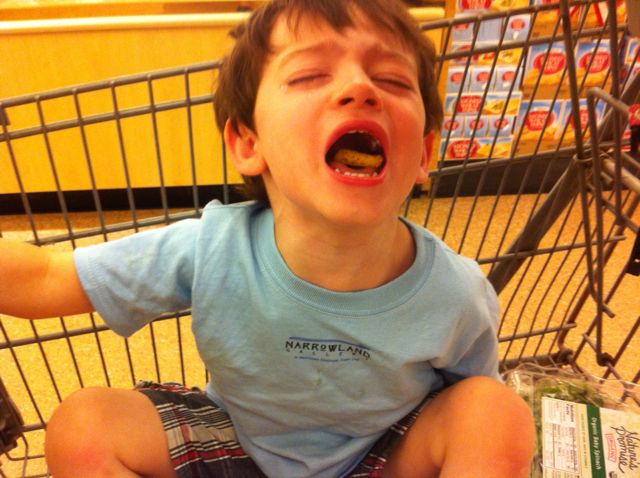
Alena gets her iced chai, Ethan gets nothing. Ethan then throws the biggest tantrum Starbucks and Stop & Shop have ever seen. As he was losing his mind on the floor of Starbucks, I actually laughed to myself, thinking, "There's no screaming in my sacred space!"
I snapped this photo of him in the produce aisle:
I'm in Starbucks now, writing in my imperfect yet sacred space. And everyone here is still talking about the tantrum...
If you've been to one of my talks or follow me on Facebook, you know I write at Starbucks. It's noisy and busy, and people know I write here now, so there's usually a distraction or two or four. The table I'm at now is wobbly, and the chair isn't ergonomically designed to protect my lumbar spine. But I love it here. It's my sacred space.
I write at Starbucks instead of in my beautiful home office because if I write at home, I end up not writing. Ethan (3) will ask me to fix the wheel on one of his trucks, Stella (10 months) will press her pudgy face up against the glass of the French doors and cry for me, Alena (11) will come in and want to chat about jump rope or school or the funny thing she just thought about. And I can't resist any of it. Or I'll think, "I really should throw in a load of laundry," or "I have bills to pay," or "I wonder if we have any chocolate?"
So I write at Starbucks.
And the Starbucks nearest me is tucked inside a Stop & Shop. With a book deadline, three kids, two in diapers, and one drinking formula, this basically means I'm here ALL THE TIME. Seriously, how many of you hug and kiss the woman who checks out your groceries? I do because I feel like I know her that well.
I was here this weekend with all three kids because I needed to pick up food for dinner. To make the chore more fun for Alena and Ethan, I told them I'd get them a treat at Starbucks. I knew Alena would want an iced chai (like her mom), and Ethan would want an apple fritter. He's obsessed with them.
So we're in line, and for no reason whatsoever, Ethan winds up and slaps Alena. We still don't know why he committed this crime. I'm blaming systemic testosterone. Toxic stuff.
I said, "Ethan, you can't hit Alena. Tell her you're sorry."
He stared at me. No way. Not happening.
"Okay, Ethan, that's not a good choice. You hit her, and you won't say sorry. You're not getting a fritter. You sure about this?"
No apology.
Alena gets her iced chai, Ethan gets nothing. Ethan then throws the biggest tantrum Starbucks and Stop & Shop have ever seen. As he was losing his mind on the floor of Starbucks, I actually laughed to myself, thinking, "There's no screaming in my sacred space!"
I snapped this photo of him in the produce aisle:
I'm in Starbucks now, writing in my imperfect yet sacred space. And everyone here is still talking about the tantrum...
Subscribe to:
Posts (Atom)